


Setup
Scorio treats repeated-trial evaluation as a tensor R in {0, 1, ..., C}L x M x N, where L is the model pool, M is the number of benchmark questions, and N is the number of stochastic trials per question.
The same input powers pointwise estimators such as avg and bayes, paired-comparison methods such as bradley_terry and elo, graph methods such as pagerank, and voting rules such as nanson.
The practical question is not just which method ranks well at N = 80, but which one remains close to the full-budget ranking when the budget is tiny.
- Reference ranking: use BayesU@80 as the correctness-based gold standard.
- Low-budget stress test: recompute rankings after subsampling one trial per question.
- Main lesson: priors and rich signals can stabilize rankings, but they can also move the target.
R.shape == (L, M, N)R0.shape == (M, D)w.shape == (C + 1,)(rankings[, scores])APIs
| Function | Family | Use |
|---|---|---|
rank.avg(R) | Pointwise | Mean correctness across repeated trials. |
rank.bayes(R, R0=None) | Bayesian | Posterior ranking with optional empirical prior and categorical weights. |
rank.pass_at_k(R, k=3) | Metric-based | At-least-one-success ranking for a fixed draw budget. |
rank.bradley_terry(R) | Pairwise | Latent-strength ranking from decisive wins and losses. |
rank.pagerank(R) | Graph | Ranking from a pairwise win-probability graph. |
Rankings are 1-indexed, and return_scores=True exposes the underlying score vector.
Ranking families
import numpy as np
from scorio import rank

# L models, M questions, N stochastic trials
R = np.random.randint(0, 2, size=(20, 30, 8))

avg_ranks, avg_scores = rank.avg(R, return_scores=True)
bayes_ranks = rank.bayes(R)             # Bayes_U@N
bt_ranks = rank.bradley_terry(R)
graph_ranks = rank.pagerank(R)- All methods read the same tensor; only the ranking rule changes.
- Use
return_scores=Truewhen you need the score vector behind the ranking. - The paper compares 72 such rules under the same repeated-trial protocol.
Empirical priors
import numpy as np
from scorio import rank

R = np.random.randint(0, 2, size=(20, 30, 1))

# Shared greedy-decoding prior across models
R0 = np.random.randint(0, 2, size=(30, 1))

uniform_ranks = rank.bayes(R)                   # Bayes_U@1
greedy_ranks = rank.bayes(R, R0=R0)            # Bayes_G@1
conservative = rank.bayes(R, R0=R0, quantile=0.05)- At
N = 1, the greedy prior can reduce the standard deviation of agreement by 16% to 52%. - That variance reduction is useful only when greedy decoding tracks the same ordering as stochastic sampling.
- Use
quantile=0.05when you want a conservative lower-bound ranking.
Categorical ranking
import numpy as np
from scorio import rank

# 0 = invalid, 1 = wrong, 2 = partial, 3 = correct
R_cat = np.random.randint(0, 4, size=(11, 120, 5))
w = np.array([0.0, 0.0, 0.5, 1.0])

scheme_ranks, scheme_scores = rank.bayes(
    R_cat,
    w=w,
    return_scores=True,
)

scheme_lcb = rank.bayes(R_cat, w=w, quantile=0.05)- Changing the ranking target is just a matter of changing labels and weights.
- Signal-rich schemes can become more self-consistent than correctness-only ranking at
N = 1. - That does not mean they stay closest to the correctness-based gold standard.
Why ranking under test-time scaling is different
- The primitive object is a response tensor, not a single accuracy number.
- Each model-question pair can be sampled repeatedly, so rankings change as the trial budget grows.
- Methods that look similar at full budget can behave very differently when only one or two trials are available.
- 1 Collect repeated trials per question
- 2 Apply one ranking family to the tensor
- 3 Use BayesU@80 as the shared gold standard
- 4 Measure agreement and convergence as N changes
- 5 Prefer rules that stay stable at low budget
Main distinction: high-budget consensus tells you what methods eventually agree on; low-budget stability tells you what you can trust in practice.
At N = 80, most reasonable methods agree
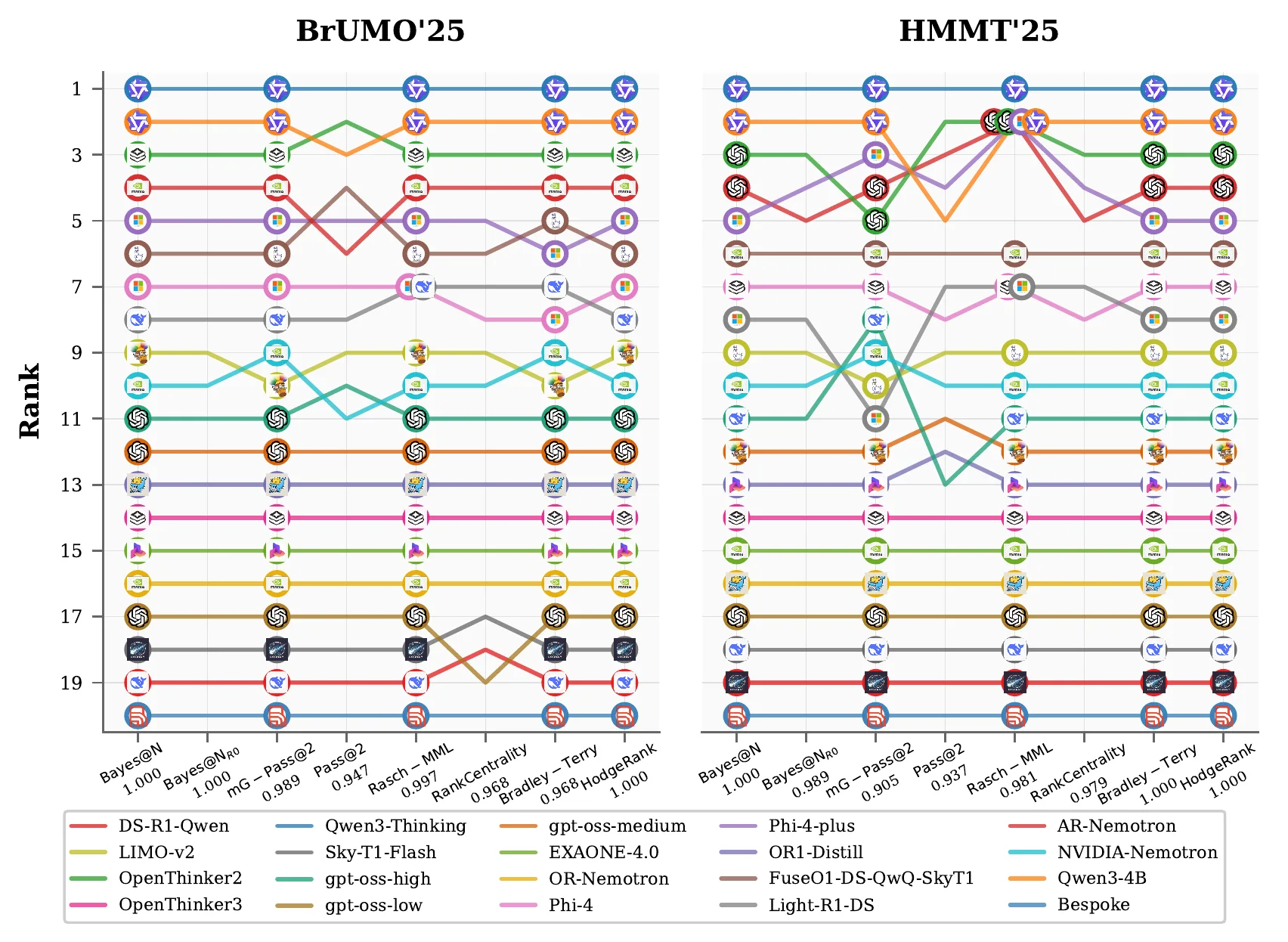
- Across the four benchmarks, the mean Kendall
τbversus BayesU@80 is 0.93 to 0.95. - Depending on the benchmark, 19 to 34 methods recover exactly the same full-trial ordering.
- Divergence concentrates on harder benchmarks and a small set of voting or difficulty-weighted rules.
Most of the practical risk is at N = 1
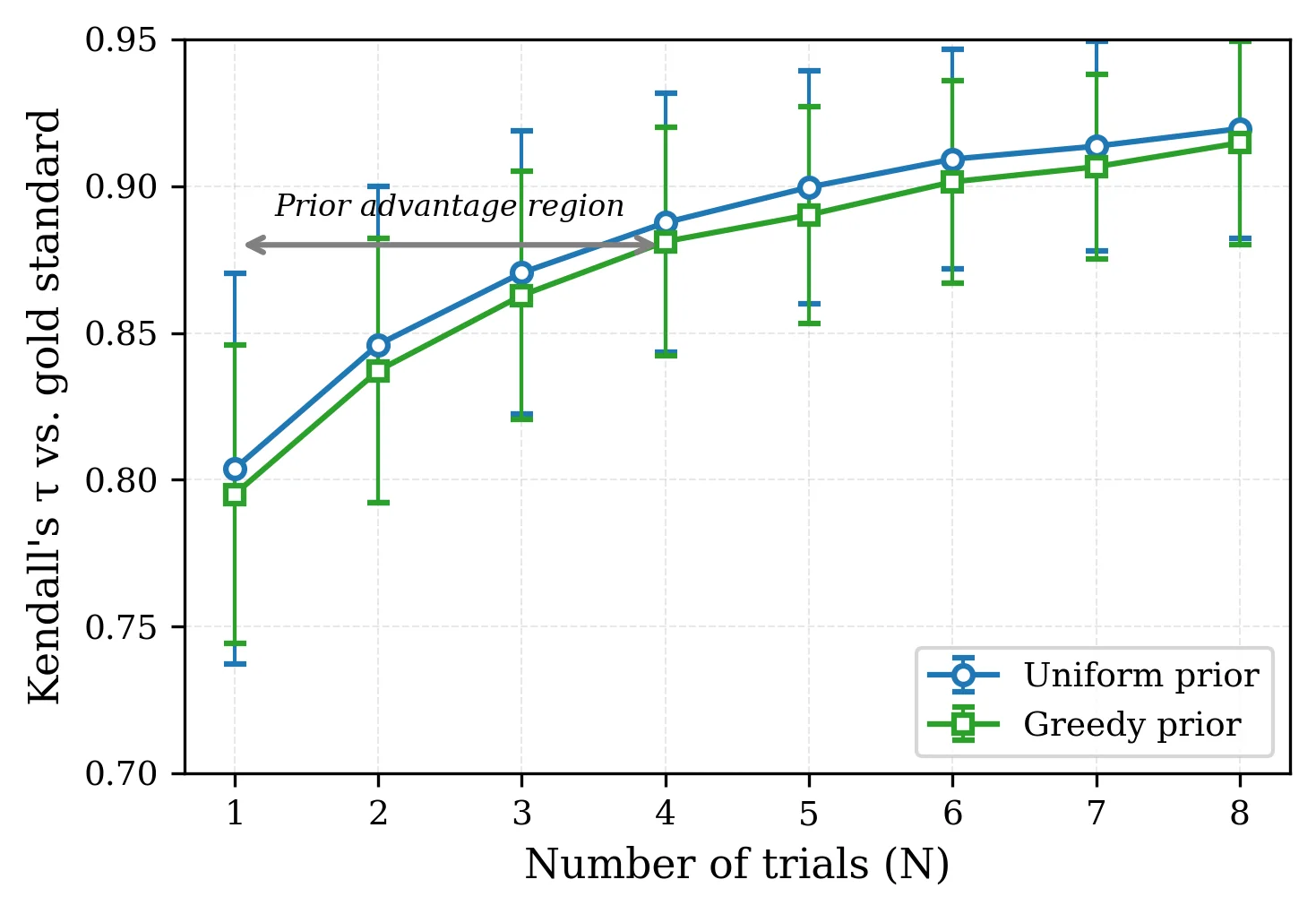
- The best methods reach
τb ≈ 0.86on the combined benchmark at a single trial. - BayesG@1 wins on AIME'24, AIME'25, and BrUMO'25, but not on HMMT'25 or the pooled benchmark.
- High self-consistency does not imply closeness to the correctness-based gold standard.
Recommendation
BayesU@N is the safe default; add a greedy prior only after checking alignment.
Greedy priors reduce variance, but can also inject bias
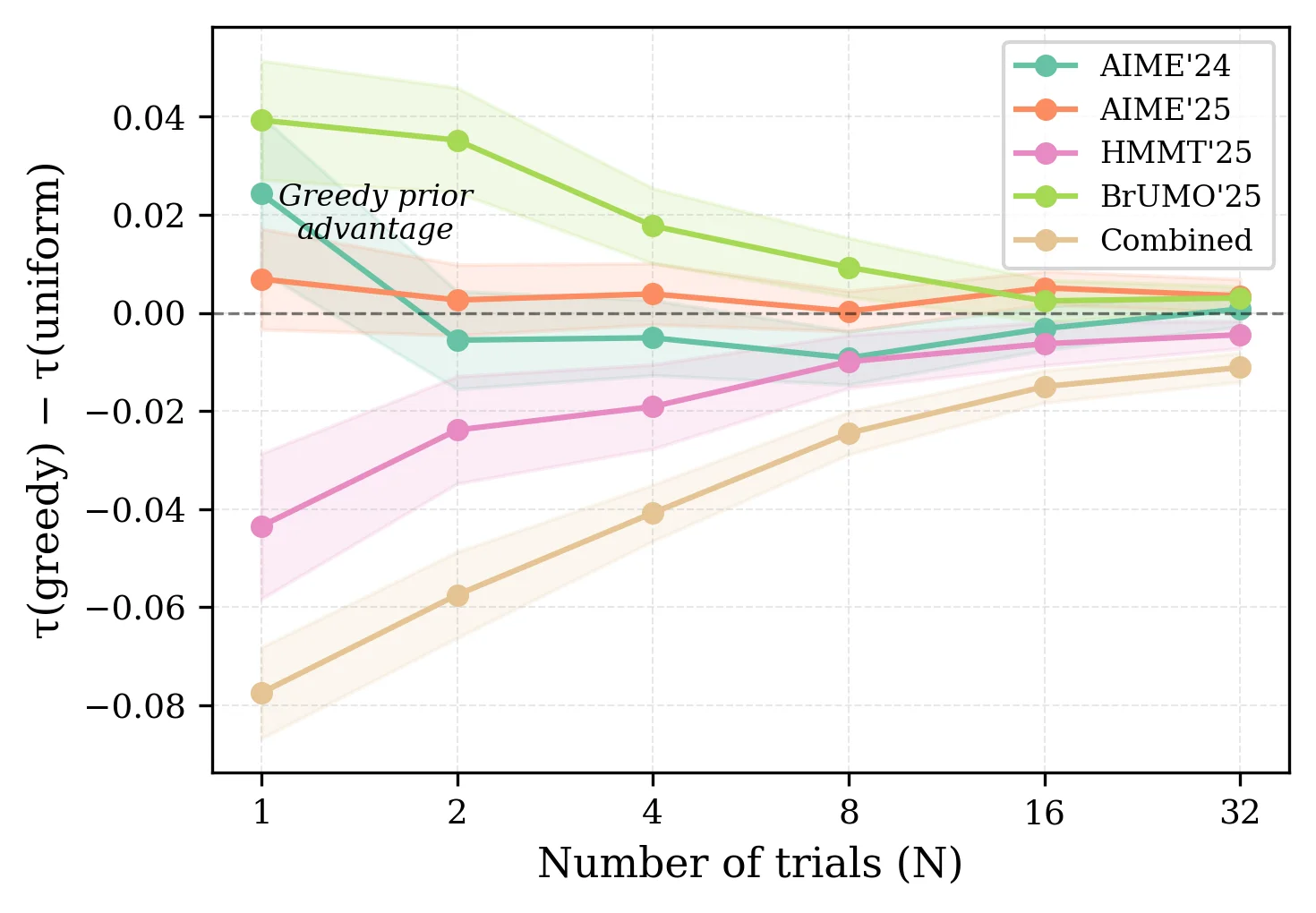
- At
N = 1, the greedy prior reduces the standard deviation of agreement by 16% to 52%. - The mean shift is positive on AIME'24, AIME'25, and BrUMO'25, but negative on HMMT'25 and Combined.
- The advantage decays quickly as new stochastic evidence accumulates.
Alignment explains when the prior helps
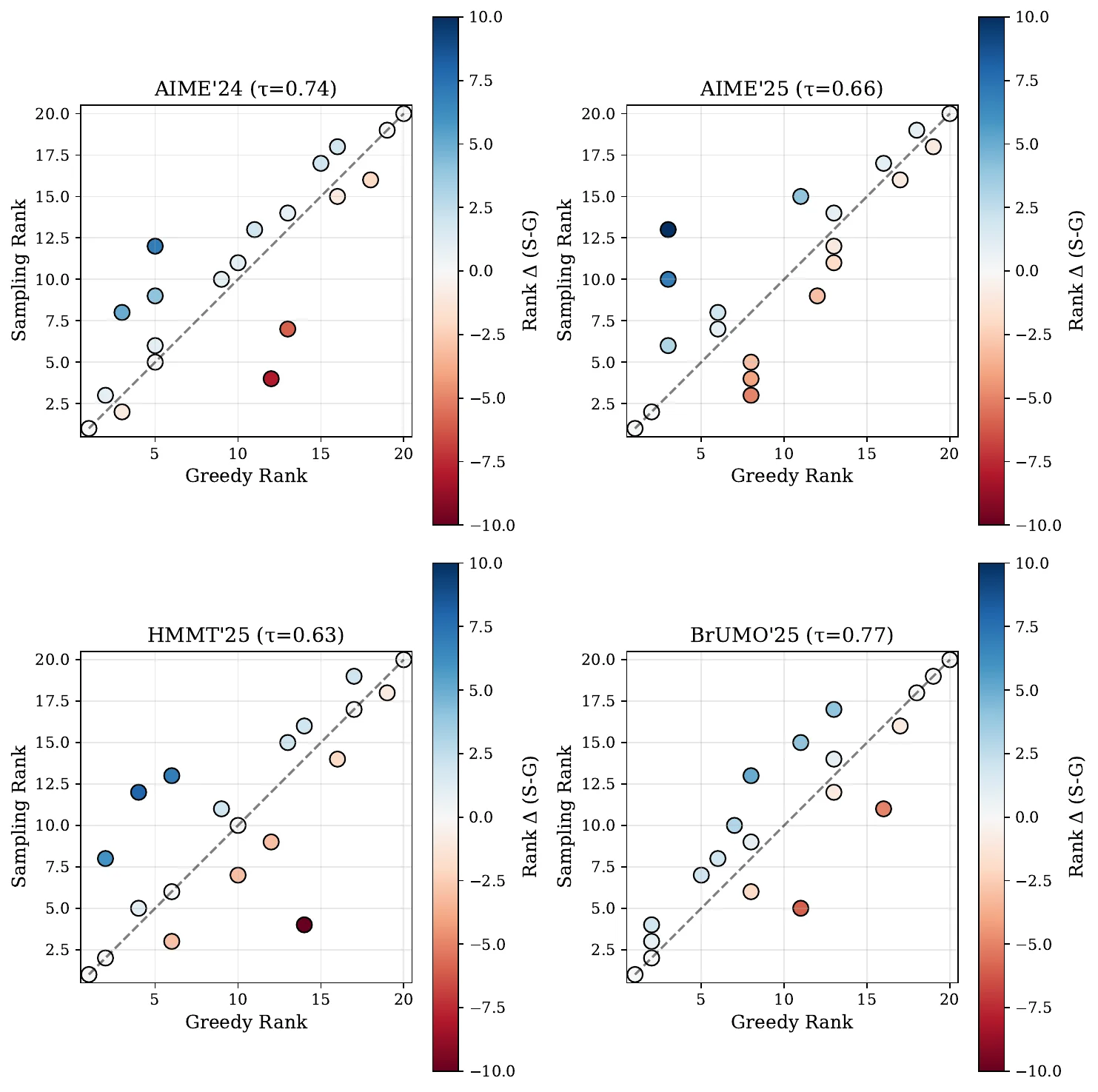
- BrUMO is the easiest benchmark and shows the largest positive prior effect.
- HMMT is harder, less aligned, and is the setting where BayesG@N hurts agreement with BayesU@80.
- Difficulty and alignment move together: when greedy decoding ceases to be a faithful proxy, shrinkage becomes bias.
Categorical schemes trade off fidelity and self-consistency
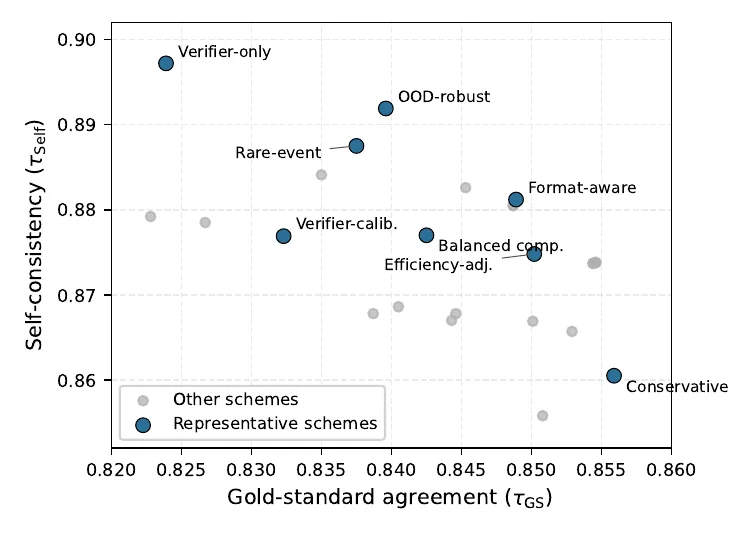
- On the combined benchmark at
N = 1, conservative ranking reachesτGS = 0.856andτSelf = 0.861. - Verifier-only ranking is more self-consistent at
0.897, but it drops to0.824against the gold standard. - Richer signals are useful when they reflect the real target, not when they are treated as a free upgrade to correctness-only ranking.
Takeaway
Categorical Bayes ranking is powerful, but the rubric has to be reported and justified.
Dense benchmark ranking under repeated sampling
Test-time scaling evaluates reasoning LLMs by drawing multiple outputs per prompt, but ranking methods in this regime have been compared much less systematically than model families. This paper fixes a correctness-based reference ranking, BayesU@80, then measures how closely alternative methods recover that ordering as the trial budget shrinks.
The main empirical result is two-part: full-budget agreement is high across most ranking families, but low-budget reliability is much less uniform. BayesU@N is the safest default, BayesG@N can help when greedy and sampling orderings are aligned, and categorical schemes must be treated as explicit target changes rather than free performance gains.
Problem setup and evaluation protocol
Response tensor
$$R \in \{0, 1, \ldots, C\}^{L \times M \times N}$$
Correctness-based reference
$$\text{Gold standard} = \mathrm{Bayes}_{\mathcal{U}}@80 \equiv \mathrm{avg}@80$$
Agreement metric
$$\tau_b\!\left(\text{method}@n,\ \mathrm{Bayes}_{\mathcal{U}}@80\right)$$
Input: repeated-trial tensor R
1. Choose a ranking family
2. Compute method@n at each budget n
3. Compare each ranking to Bayes_U@80
4. Average agreement across resamples
5. Prefer rules that stay close at small n- Pointwise methods operate directly on per-question solve rates or posterior summaries.
- Pairwise, graph, and voting rules collapse the tensor into other comparison structures before ranking.
- The paper separates correctness-based ranking from richer categorical targets instead of mixing them together.
Full-budget agreement is high but not uniform
- Average Kendall
τbwith BayesU@80 ranges from 0.93 to 0.95 across benchmarks. - Between 19 and 34 methods recover exactly the same full-trial ordering, depending on the dataset.
- The worst disagreements come from a small tail of voting rules and difficulty-weighted baselines rather than from the main Bayesian and pairwise families.
- That high-budget consensus explains why the low-budget regime is the decisive comparison.
Single-trial ranking separates the useful defaults from the brittle ones
- BayesG@1 is the best method on the three better-aligned individual benchmarks.
- On the hardest benchmark and on the pooled evaluation, the same shrinkage becomes a liability, so BayesU@1 stays in the tied best class.
- The best self-consistent method is not always the method closest to the gold standard.
Why the greedy prior helps some datasets and hurts others
Interpretation
A prior is shrinkage toward the greedy ordering. Shrinkage helps only when that ordering is a faithful proxy for the stochastic ranking target.
τb at N = 1.- Alignment is not an abstract diagnostic; it predicts the sign of the prior effect.
- The empirical trend suggests a simple policy: run a pilot, measure greedy-sampling agreement, and only then decide whether to inject
R0.
Categorical ranking changes the target, not just the estimator
- Eight representative schemes were selected from a larger family spanning correctness, format, verifier, efficiency, OOD, and abstention signals.
- Verifier-only and OOD-robust schemes are among the most self-consistent but also among the furthest from BayesU@80.
- Correctness-driven schemes remain above
τGS = 0.80on the harder benchmarks, while verifier-heavy schemes degrade more sharply. - The right interpretation is target design: if the rubric matters, rank under that rubric and report it explicitly.
Practical rule
Do not describe categorical ranking as a free improvement over correctness-only evaluation. It is a different objective with different tradeoffs.
Scorio makes the comparison space explicit
from scorio import rank

rank.avg(R)
rank.bayes(R, R0=None, quantile=None)
rank.pass_at_k(R, k=3)
rank.bradley_terry(R)
rank.pagerank(R)- The same API surface lets you swap ranking families without changing the evaluation tensor.
- That makes the methodological comparison reproducible instead of embedding ranking choices in ad hoc scripts.