


Setup
Scorio starts from a results matrix R with M problems by N trials and turns evaluation into posterior inference over question-level outcome probabilities instead of an at-least-one-success surrogate like Pass@k.
The core move is to tally category counts per question, combine them with a Dirichlet prior, and return a closed-form posterior mean mu, uncertainty sigma, and optional credible bounds through one shared API.
The same pipeline covers binary correctness, rubric-weighted scoring, and prior transfer through R0; on AIME, HMMT, and BrUMO, this gives faster convergence and more stable rankings than Pass@k.
- Why replace Pass@k? It tracks at least one success in
ktries, which can reshuffle rankings whenNis small. - What Bayes@N adds: exact posterior uncertainty, interval-aware decisions, and one inference layer for binary or categorical outcomes.
- What stays simple: change labels in
R, change weights inw, and optionally passR0when earlier evidence is justified.
R.shape == (M, N)w.shape == (C + 1,)R0.shape == (M, D)(mu, sigma[, lo, hi])APIs
| Function | Returns | Description |
|---|---|---|
bayes(R, w=None, R0=None) | (μ, σ) | Posterior mean and uncertainty for binary or categorical outcomes. |
bayes_ci(R, w=None, R0=None) | (μ, σ, lo, hi) | Bayes@N with a credible interval. |
avg(R, w=None) | (a, σa) | Average score with Bayesian uncertainty calibration. |
avg_ci(R, w=None) | (a, σa, lo, hi) | Avg@N with a credible interval. |
pass_at_k(R, k) | p | Pass@k estimate for binary outcomes. |
pass_at_k_ci(R, k) | (μ, σ, lo, hi) | Pass@k with a credible interval. |
pass_hat_k(R, k) | p | Pass^k, the all-correct probability. |
g_pass_at_k_tau(R, k, tau) | p | Generalized Pass@k with threshold tau. |
mg_pass_at_k(R, k) | p | Mean generalized Pass@k across majority thresholds. |
Companion *_ci variants return (mu, sigma, lo, hi).
Credible interval
import numpy as np
from scorio import eval

# Binary outcomes: 1 = correct, 0 = incorrect
R = np.array([
    [0, 1, 1, 0, 1],
    [1, 1, 0, 1, 1],
])

k = 3
tau = 2 / 3  # require at least 2 correct out of 3

mu, sigma, lo, hi = eval.bayes_ci(R, bounds=(0.0, 1.0))
print(f"Bayes@N: mu={mu:.6f}, sigma={sigma:.6f}, CI=[{lo:.6f}, {hi:.6f}]")

mu, sigma, lo, hi = eval.avg_ci(R, bounds=(0.0, 1.0))
print(f"Avg@N: mu={mu:.6f}, sigma={sigma:.6f}, CI=[{lo:.6f}, {hi:.6f}]")

mu, sigma, lo, hi = eval.pass_at_k_ci(R, k)
print(f"Pass@{k}: mu={mu:.6f}, sigma={sigma:.6f}, CI=[{lo:.6f}, {hi:.6f}]")

mu, sigma, lo, hi = eval.g_pass_at_k_tau_ci(R, k, tau)
print(f"G-Pass@{k} (tau={tau:.3f}): mu={mu:.6f}, sigma={sigma:.6f}, CI=[{lo:.6f}, {hi:.6f}]")

mu, sigma, lo, hi = eval.mg_pass_at_k_ci(R, k)
print(f"mG-Pass@{k}: mu={mu:.6f}, sigma={sigma:.6f}, CI=[{lo:.6f}, {hi:.6f}]")bayes_ci,avg_ci,pass_at_k_ci,g_pass_at_k_tau_ci, andmg_pass_at_k_ciall return(mu, sigma, lo, hi).- The Pass interval calls are binary-only; use
bayes_ciwith rubric weights in categorical evaluation.
Prior knowledge
import numpy as np
from scorio import eval

# R: results from top-p sampling
R = np.array([
    [0, 1, 2, 2, 1],
    [1, 1, 0, 2, 2],
])

# R0: results from greedy sampling on the same questions
R0 = np.array([
    [2],
    [1],
])

w = np.array([0.0, 0.5, 1.0])

mu, sigma = eval.bayes(R, w)
print(f"Top-p only: mu={mu:.6f}, sigma={sigma:.6f}")

mu, sigma = eval.bayes(R, w, R0)
print(f"Top-p + greedy prior: mu={mu:.6f}, sigma={sigma:.6f}")

# Expected:
# Top-p only: mu=0.562500, sigma=0.091998
# Top-p + greedy prior: mu=0.583333, sigma=0.085165- Use
R0to reuse pilot data, earlier benchmarks, or related previous runs. - The results from one sampling strategy can serve as a prior for another.
- The main evaluation call stays the same; the prior just becomes another input to the posterior.
Categorical evaluation
import numpy as np
from scorio import eval

# 0 = incorrect, 1 = partial credit, 2 = correct
R = np.array([
    [0, 1, 2, 2, 1],
    [1, 1, 0, 2, 2],
])

w = np.array([0.0, 0.5, 1.0])

mu, sigma = eval.bayes(R, w)
print(f"Bayes@N: mu={mu:.6f}, sigma={sigma:.6f}")

# 0 = invalid, 1 = wrong-high-confidence, 2 = wrong-low-confidence, 3 = correct
R_conf = np.array([
    [3, 2, 3, 1, 3],
    [2, 3, 0, 3, 1],
])
w_conf = np.array([0.0, 0.0, 0.25, 1.0])

mu, sigma, lo, hi = eval.bayes_ci(R_conf, w_conf)
print(f"Confidence-aware: mu={mu:.6f}, sigma={sigma:.6f}, CI=[{lo:.6f}, {hi:.6f}]")

# Bayes@N: mu=0.562500, sigma=0.091998
# 95% CrI: [0.382188, 0.742812]
# Confidence-aware rubric: mu=0.444444, sigma=0.100539, CI=[0.247392, 0.641497]- This example uses three categories: incorrect, partial credit, and correct.
- Changing the score semantics is just a matter of changing labels in
Rand weights inw.
Why replace Pass@k?
- Pass@k estimates the probability of at least one success in k tries, not a model's underlying success probability.
- With limited samples, rankings can be unstable and sensitive to decoding and sampling noise.
- It lacks a simple closed-form uncertainty estimate and does not naturally extend to partial-credit rubrics.
- 1 Run N samples per question
- 2 Score each attempt (binary/rubric)
- 3 Tally category counts
- 4 Dirichlet posterior over outcomes
- 5 Report μ, σ, and CIs
Bayes@N turns evaluation into posterior inference over question-level outcome probabilities.
Convergence and Rank Stability
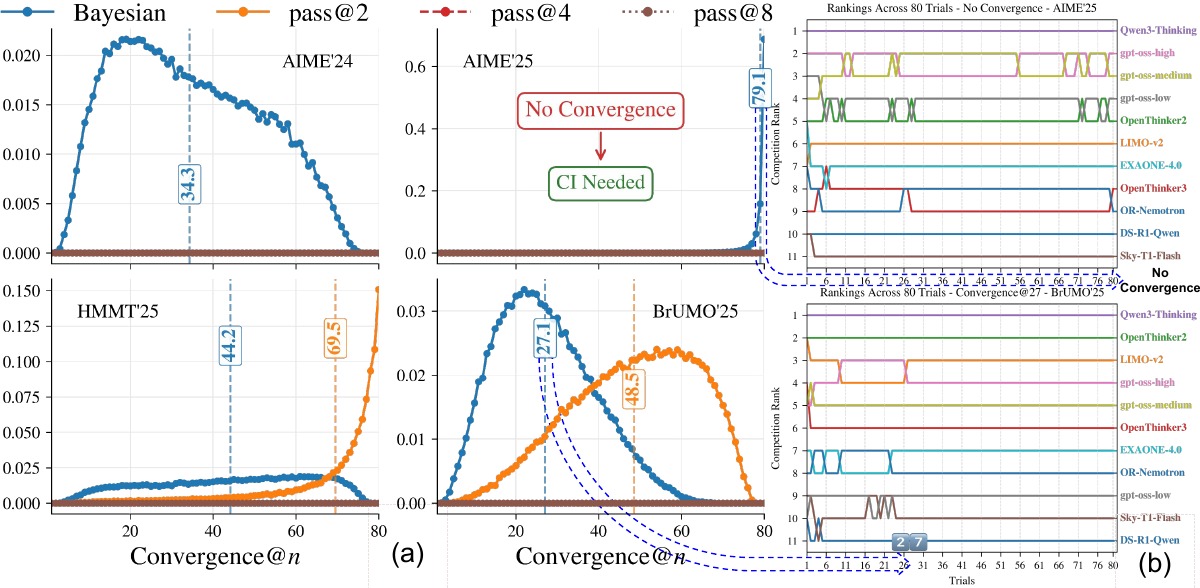
Convergence@n
PMFs compare Bayes@N with pass@2/4/8 across AIME'24/'25, HMMT'25, and BrUMO'25.
Ranking traces show fast convergence on BrUMO'25 and non-convergence on AIME'25.
Benchmarks: rankings with fewer trials
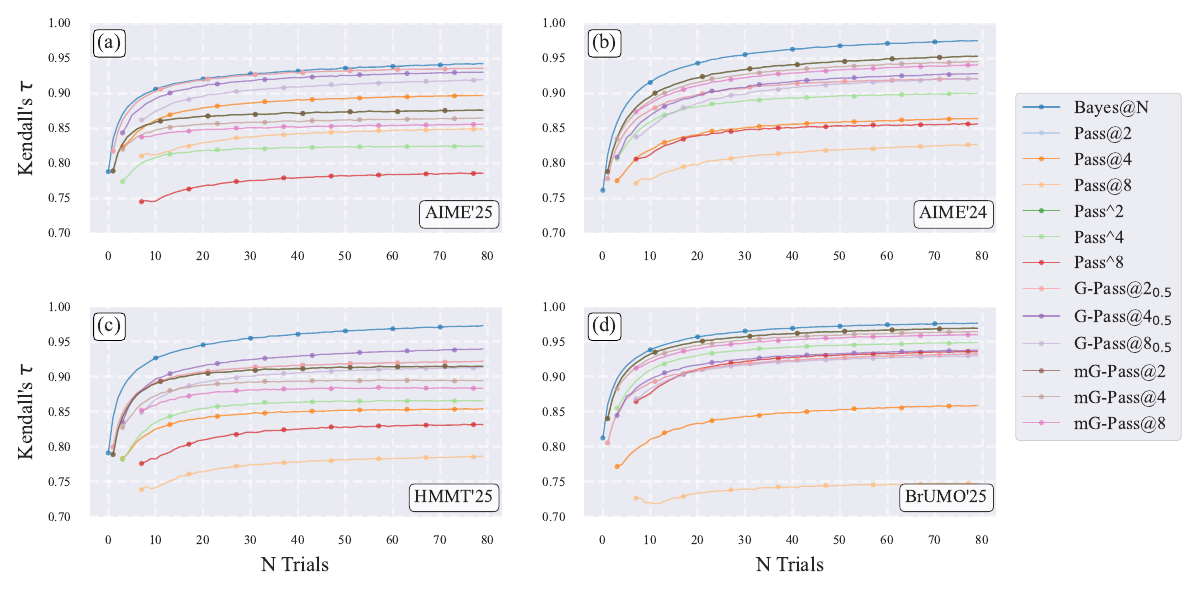
- On AIME'24, AIME'25, HMMT'25, and BrUMO'25, Bayes@N reaches τ > 0.90 by N = 10 and tracks the gold-standard ranking much faster than Pass@k.
- AIME'25 remains partially unresolved even at N = 80, showing why interval-aware reporting is necessary.
Bayesian estimator and the decision rule
Posterior on question α:
$$\pi_{\alpha} \mid R_{\alpha} \sim \mathrm{Dir}\left(n^{0}_{\alpha 0} + n_{\alpha 0}, \ldots, n^{0}_{\alpha C} + n_{\alpha C}\right)$$
Weighted rubric metric:
$$\bar{\pi} = \frac{1}{M} \sum_{\alpha} \sum_{k} w_k \pi_{\alpha k}$$
- Output both a posterior mean \(\mu(R)\) and exact uncertainty \(\sigma(R)\).
- Binary evaluation is a special case; categorical rubrics use the same machinery.
- Under a uniform prior in the binary case, Bayes@N has the same ordering as avg@N / Pass@1, but adds principled uncertainty.
Practical rule
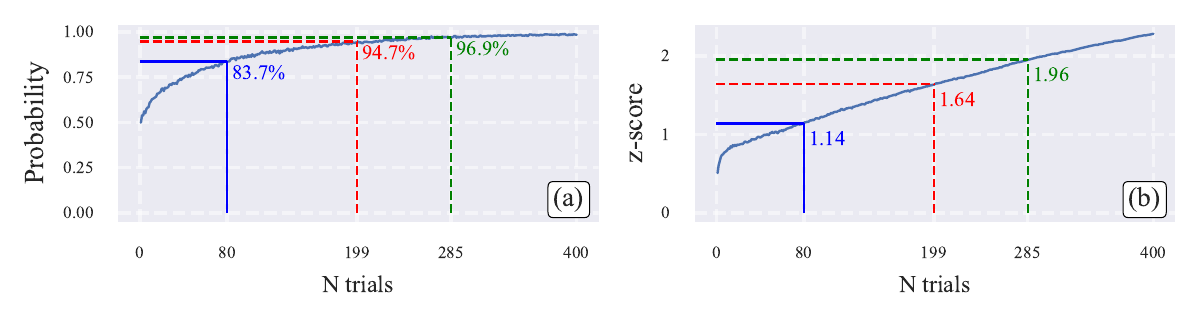
If credible intervals overlap, do not call a winner. For pairwise rankings, z = 1.645 implies 95% confidence in the ordering.
Recommended protocol: sample N attempts, score each attempt with a binary or rubric-aware labeler, report Bayes@N with credible intervals, then extend N only if needed.
Leaderboard grows -> interval-aware evaluation matters more
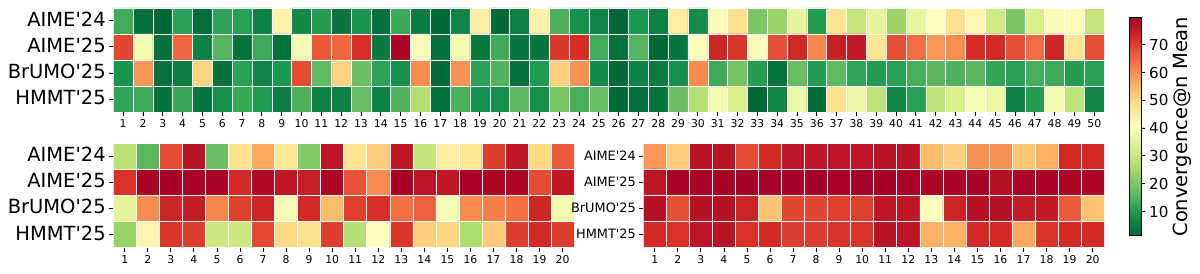
- Mean convergence@n worsens as the number of compared models increases from 5 to 15.
- Without credible intervals, many subsets fail to stabilize within 80 trials; scaling to 20 models makes the problem severe on all four datasets.
- Posterior intervals provide a transparent stopping rule when strict point-estimate rankings are not yet trustworthy.
Beyond binary correctness: rubric-aware Bayes@N
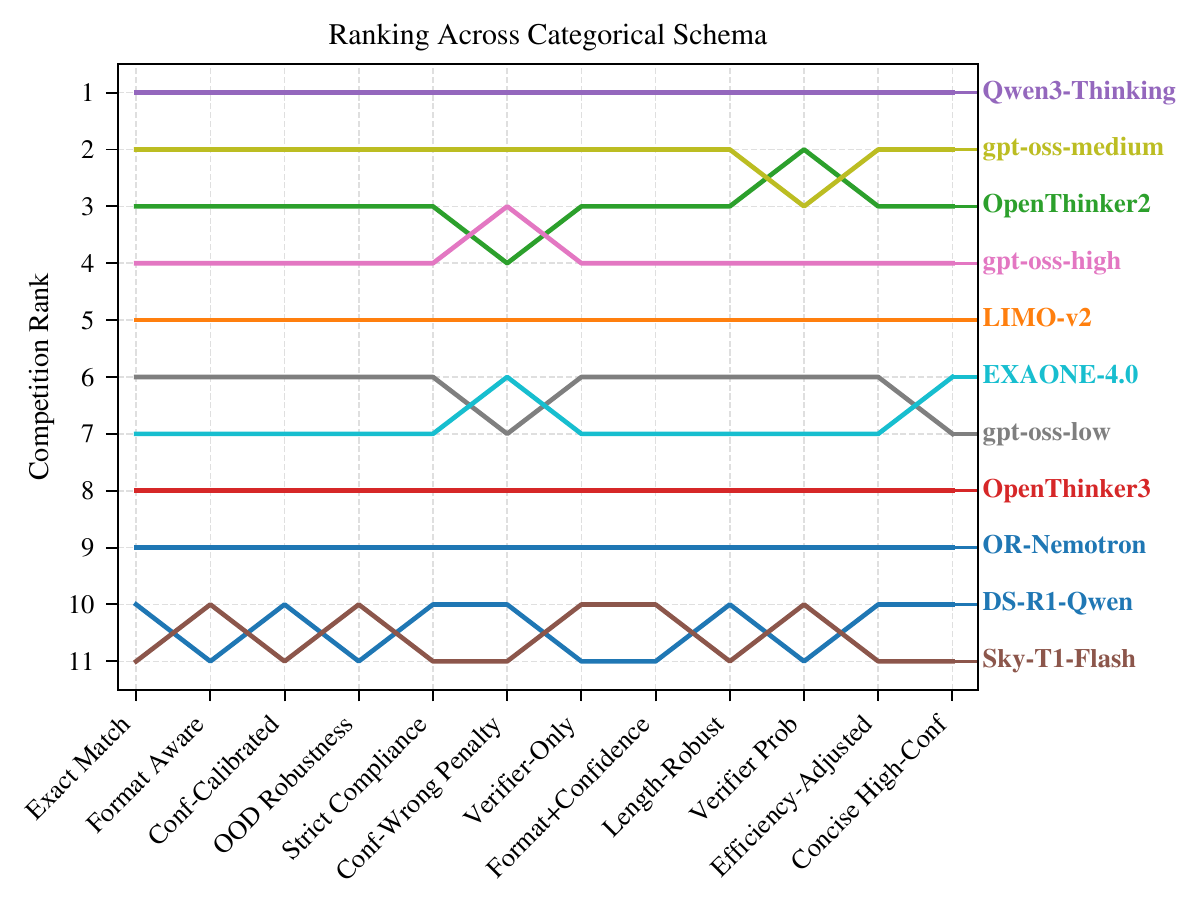
- Treat outcomes as categorical: correct, partial credit, format errors, refusals, verifier signals, efficiency penalties, and more.
- Different weight vectors encode different evaluation goals while keeping posterior uncertainty explicit.
- Across schemas, Qwen3-Thinking remains first; rubric choice mainly reshuffles the middle of the pack.
 Qwen3-Thinking
Takeaway: replace Pass@k with Bayes@N + credible intervals for stable, uncertainty-aware ranking, and use categorical scoring beyond 0/1 correctness.
Acknowledgment: This research was supported in part by NSF awards 2117439, 2112606, & 2320952.
Bayes@N as Dirichlet-multinomial posterior inference
Pass@k estimates the probability of at least one success in k tries, which is not the same as the latent per-question success distribution of a model. Bayes@N starts from an \(M \times N\) result matrix \(R_{\alpha i} \in \{0, \ldots, C\}\), places a Dirichlet prior on each question-level outcome vector \(\pi_{\alpha}\), and evaluates the weighted target \(\bar{\pi} = \frac{1}{M} \sum_{\alpha} \sum_{k} w_k \pi_{\alpha k}\). This turns evaluation into posterior inference over latent outcome probabilities rather than an at-least-one-success surrogate.
Because the posterior is conjugate, Bayes@N yields exact closed-form expressions for \(\mu(R)\) and \(\sigma(R)\), supports prior evidence through an optional \(M \times D\) matrix \(R^{0}\), and gives an operational stopping rule: rank by posterior mean, merge unresolved comparisons with credible intervals, and spend additional trials only where the z-score is still too small. The same construction covers binary correctness, partial-credit rubrics, format-sensitive scoring, verifier-based labels, and efficiency-aware penalties.
Problem setup and posterior construction
Run the model \(N\) times on each of \(M\) questions and record categorical labels \(R_{\alpha i} \in \{0, \ldots, C\}\). For question \(\alpha\), the latent probability simplex is \(\pi_{\alpha} = (\pi_{\alpha 0}, \ldots, \pi_{\alpha C})\).
Weighted metric over latent outcome probabilities
$$\bar{\pi} = \frac{1}{M} \sum_{\alpha=1}^{M} \sum_{k=0}^{C} w_k \pi_{\alpha k}$$
Posterior for each question
$$\pi_{\alpha} \mid R_{\alpha} \sim \mathrm{Dir}(\nu_{\alpha 0}, \ldots, \nu_{\alpha C}), \quad \nu_{\alpha k} = n_{\alpha k} + n^{0}_{\alpha k}$$
Uniform or informative prior counts
$$n^{0}_{\alpha k} = 1 + \sum_{i=1}^{D} \delta_{k, R^{0}_{\alpha i}}, \qquad T = 1 + C + D + N$$
- Binary correctness is the special case \(C = 1\) with weights \([0, 1]\).
- Categorical scoring simply changes the labels and the weight vector w; the inference machinery is unchanged.
- The optional prior matrix \(R^{0}\) makes prior evidence explicit rather than hidden in a heuristic.
Closed-form estimator, uncertainty, and avg@N equivalence
Posterior mean
$$\mu = w_0 + \frac{1}{MT} \sum_{\alpha=1}^{M} \sum_{j=0}^{C} \nu_{\alpha j}(w_j - w_0)$$
Posterior variance
$$\sigma^{2} = \frac{1}{M^{2}(T + 1)} \sum_{\alpha=1}^{M} \left\{ \sum_{j=0}^{C} \left(\frac{\nu_{\alpha j}}{T}\right)(w_j - w_0)^{2} - \left[\sum_{j=0}^{C} \left(\frac{\nu_{\alpha j}}{T}\right)(w_j - w_0)\right]^{2} \right\}$$
Uniform-prior relationship to avg@N
$$\mu = A + \frac{N}{1 + C + N} a$$
- Under a uniform prior, Bayes@N and avg@N induce exactly the same ordering, but Bayes@N also outputs exact uncertainty.
- The formulas are valid at finite M and N; they do not rely on CLT, Wald intervals, or asymptotic normality.
- For small benchmarks, this avoids the interval pathologies that appear when uncertainty is approximated too aggressively.
Algorithm
EvaluatePerformance(R, [R0], w):
  T = 1 + C + D + N
  for alpha in 1..M:
    for k in 0..C:
      n_alpha_k  = sum_i delta(k, R_alpha_i)
      n0_alpha_k = 1 + sum_i delta(k, R0_alpha_i)
      nu_alpha_k = n_alpha_k + n0_alpha_k
  mu = w0 + (1 / MT) sum_alpha sum_j nu_alpha_j (w_j - w0)
  sigma = sqrt(closed-form variance on nu / T)
return mu, sigma- No iterative optimization, sampling-based posterior estimation, or bootstrap is required to compute μ and σ.
- The only state the evaluator needs is the count table per question and category.
- This is why Bayes@N is practical even when the benchmarking budget is dominated by model inference rather than post-processing.
Convergence to the gold ranking
- The paper uses Bayes@80, equivalently avg@80, as the practical gold-standard ranking for finite-budget experiments.
- Across AIME'24, AIME'25, HMMT'25, and BrUMO'25, Bayes@N reaches Kendall τ > 0.90 by N = 10; only AIME'25 remains below full convergence at N = 80.
- Mean convergence@n is about 44.2 on HMMT and 27.1 on BrUMO for Bayes@N, versus roughly 69.5 and 48.5 for the best Pass@k alternatives.
- Worst-case bootstrap trajectories still need N = 75 on AIME'24, N = 78 on HMMT, N = 68 on BrUMO, and do not converge within 80 trials on AIME'25.
Decision rule and confidence
Pairwise ranking confidence
$$z = \frac{|\mu - \mu'|}{\sqrt{\sigma^{2} + (\sigma')^{2}}}, \qquad \rho = \frac{1}{2}\left(1 + \operatorname{erf}\left(\frac{z}{\sqrt{2}}\right)\right)$$
- The biased-coin experiment shows why a strict rank ordering at N = 80 can be overconfident: some adjacent gaps are still statistically unresolved.
- At the benchmark level, AIME'25 has the most compressed Bayes@80 ranking with credible intervals, signaling that additional trials are required.
Categorical rubrics
Format Aware schema
- Twelve categorical schemata in the paper combine correctness, boxing, confidence, verifier signals, OOD behavior, and efficiency into a unified posterior framework.
- Across selected schemata, Qwen3-Thinking remains first, while rubric choice mostly changes the middle ranks.
- Several schema families agree closely at the top and bottom of the leaderboard, with most movement concentrated in the middle ranks.
- Bayes@N quantifies finite-sample uncertainty in the chosen rubric; it does not fix benchmark bias or bad rubric design, so schemas must be reported explicitly.
Takeaway
Bayes@N is a single inference layer for binary accuracy, graded rubrics, and interval-aware ranking.
Potential benefits of non-uniform priors
Takeaway
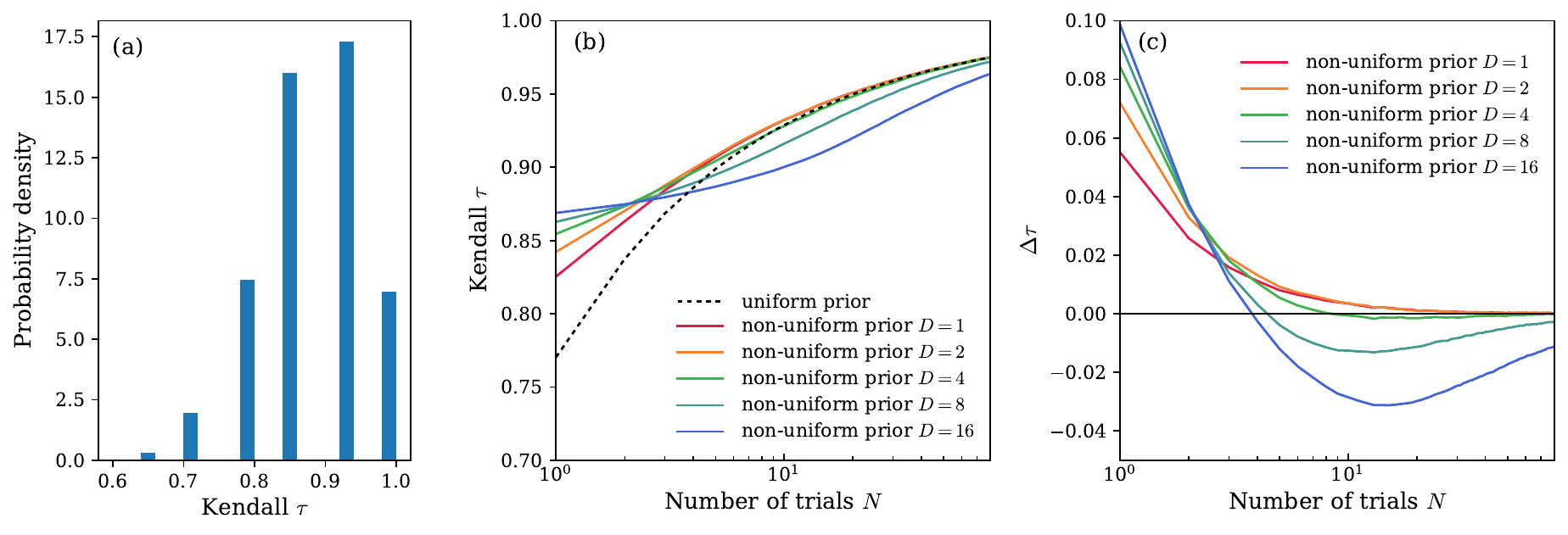
Non-uniform priors can accelerate convergence when the old and new rankings are correlated, but D must be chosen judiciously and reported explicitly.
- Panel (a): over 50k updates, old and new rankings have mean Kendall τ ≈ 0.88.
- Panel (b): at low N, modest priors beat the uniform prior.
- Best early gains come from small prior depth: D = 1, 2, or 4.
- Panel (c): large D eventually hurts by overpowering new evidence.