Medical Image Spatial Grounding with Semantic Sampling

MIS-Ground · MIS-SemSam

Interactive poster

Andrew Seohwan Yu Mohsen Hariri Kunio Nakamura Mingrui Yang Xiaojuan Li Vipin Chaudhary

Equal contribution

3D grounding fails on the language side, not the eyes

  • VLMs name anatomy correctly yet misplace it: small decoding shifts flip directional terms (superiorinferior), an error that compounds under chain-of-thought reasoning.
  • A 3D volume is an ordered stack of slices, so video-native VLMs read it directly — but no benchmark isolates where grounding breaks.
  • We vary five factors and fix one failure mode at decode time, free.

ModalityCT · MRI

Sliceaxial / coronal / sagittal

CoordinatesRAS storage vs. viewing

Visual promptmask · box · point

Termsanatomical vs. colloquial

MIS-Ground probes grounding under a controlled factorial design

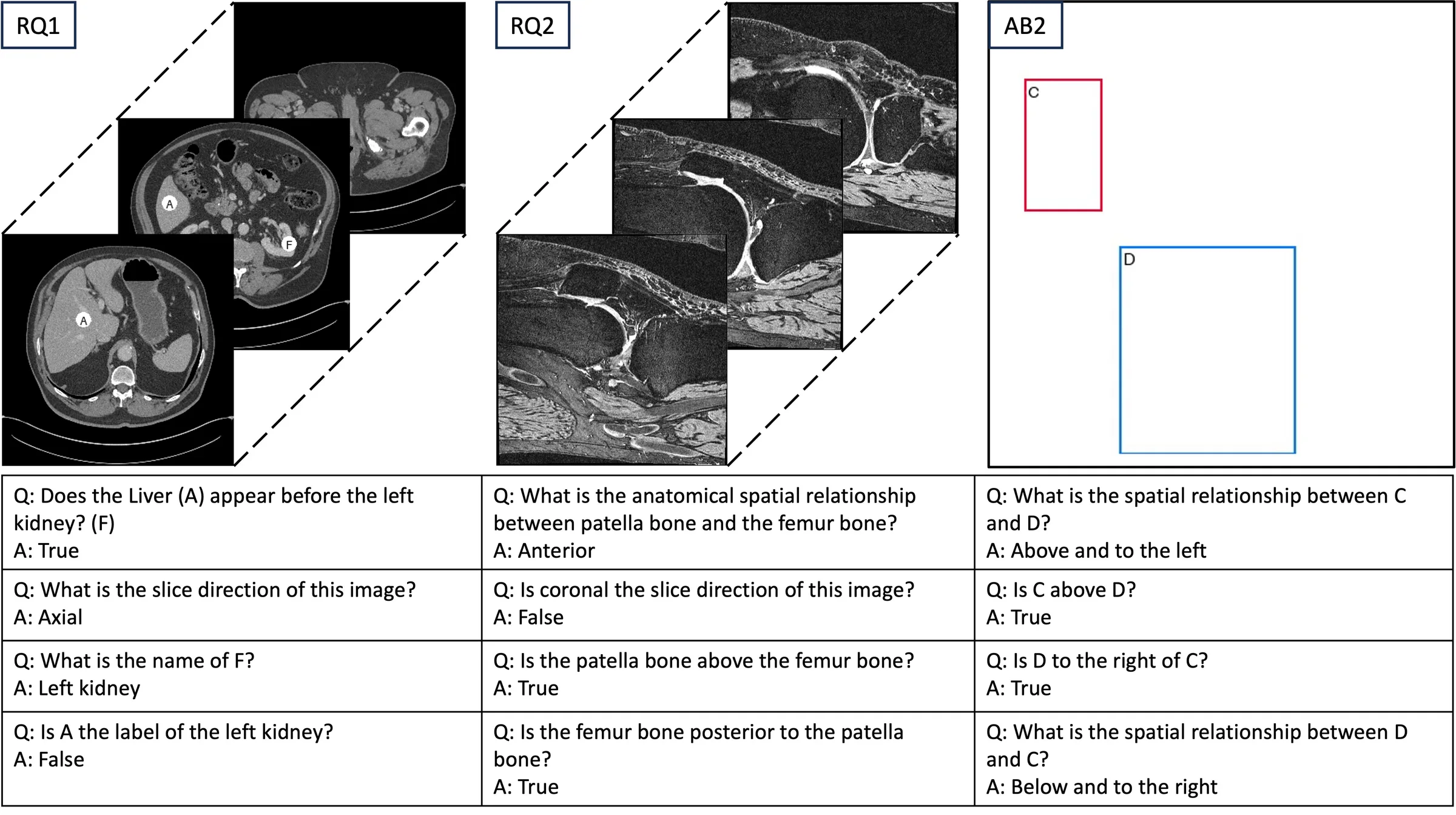
Sample question-answer pairs from MIS-Ground showing CT and MRI slices with labeled anatomical prompts and spatial-relationship questions
Each 2D/3D input spawns many questions: cross-slice relationships (RQ1), anatomical vs. colloquial terms (RQ2), and abstract reasoning on bare prompts (AB2).

1,1603D volumes · 2,320 2D slices

33,864spatial-grounding questions

77anatomical components (67 CT, 10 MRI)

CT from TotalSegmentator (1,228 torso scans, ~84% of the set, avg 2,757 Q/scan); MRI from OAI knee (209 DESS scans, avg 683 Q/scan). First benchmark to jointly vary modality, slice, coordinates, prompt, and terminology.

Semantic Sampling stabilizes decoding for free

At each step, keep the standard top-M/top-p candidates, then re-score every content token by the probability mass of its cosine-kNN neighborhood in embedding space — coherent regions win over locally lucky tokens.

Scoret(c)=kK(c)wc,kpt(Stid[c,k]),wc,k=max(0,Sval[c,k])\text{Score}_t(c)=\sum_{k\in\mathcal{K}(c)} w_{c,k}\, p_t\big(S_{\text{tid}}[c,k]\big),\quad w_{c,k}=\max(0, S_{\text{val}}[c,k])
  • Neighborhoods are built over content tokens only; special, control, and modality markers are excluded so they cannot become embedding hubs.
  • If any candidate is a non-content token, the step defers to default decoding.
  • Pick argmax\arg\max for reproducibility, or softmax-sample for chain-of-thought.
Training-free Model-agnostic No extra forward pass O(|It|·K) lookups/token

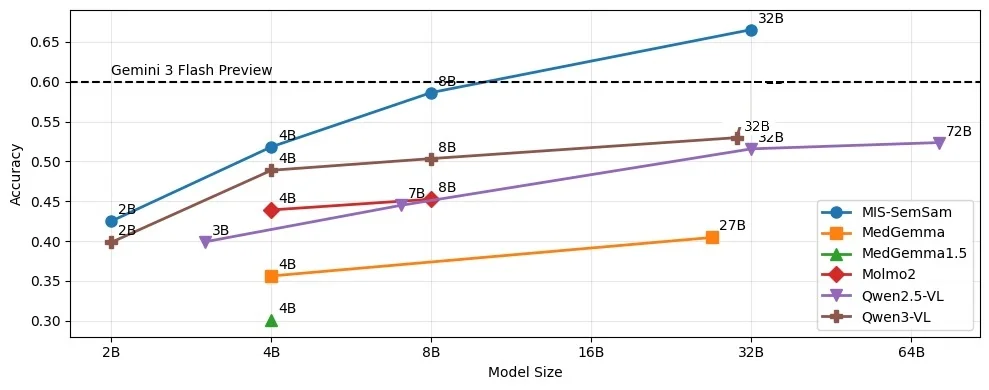
Semantic Sampling lifts Qwen3-VL-32B to 66.5%

Line plot of overall MIS-Ground accuracy versus model size across model families, with the MIS-SemSam curve highest and crossing the Gemini 3 Flash Preview reference line
Accuracy climbs with model size; MIS-SemSam (Qwen3-VL-32B + semantic sampling) tops every open-weights family and the Gemini 3 Flash reference.

53.4%Qwen3-VL-32B, default decoding

66.5%+ MIS-SemSam  (+13.06%)

Same model, prompts, images, and questions — only the token-selection rule changes, so the gain is a paired comparison. M3D (15.9%) and Med3DVLM (0.0%, malformed output) trailed on resizing and rigid formatting, not on spatial capacity.

What MIS-Ground reveals about 3D grounding

RQ1 3D nearly matches 2D

Slice direction predicted at 77.6%; cross-slice relationships 68.0% vs. in-plane 71.7%. Overall 3D 56.9% tracks 2D 58.8%.

RQ2 View flips the preferred terms

Standard viewing favors anatomical terms (69.4% vs. 57.8%); RAS storage inverts it (colloquial 59.9% vs. anatomical 50.2%) as priors fight the non-standard view.

RQ3 Prompts help only when text is weak

From a 57.6% standard-view baseline, prompts add little (+2–3%). They degrade a strong 75.3% anatomical baseline (−13.3% points) yet rescue a weak 45.1% colloquial one (+8.2%).

AB1 Heavy reliance on anatomy priors

Text-only (no image) anatomical relationships hold at 69.3% vs. 74.0% with the image; colloquial text-only collapses to 40.4%.

AB2 Capable abstract reasoning

Prompts on a blank background, no scan: points 64.2%, boxes 60.4% — spatial reasoning survives without the medical image.

Setup Robust, reproducible eval

Reasoning decode, max 8,912 new tokens, T=0.5T{=}0.5; accuracy reported with Bayesian credible intervals over limited trials.

Takeaways

  • 3D anatomical grounding is measurable, not random — MIS-Ground isolates where VLMs break instead of reporting one aggregate failure.
  • The bottleneck is language-side brittleness — conflicts between anatomy priors and the on-screen view drive most errors.
  • Semantic Sampling buys accuracy at no cost — +13.06% on Qwen3-VL-32B with no training and no extra forward pass.

Fix decoding, not the model: aggregating semantic-neighborhood mass at the final token choice recovers grounding that default sampling throws away.

Acknowledgment: This research was supported in part by NSF awards 2117439 and 2320952. Affiliations: Case Western Reserve University and Cleveland Clinic, Cleveland, OH, USA.